How to open a bank account in Dubai as a new resident
By Giles Thomas · Last checked 14 Oct 2026
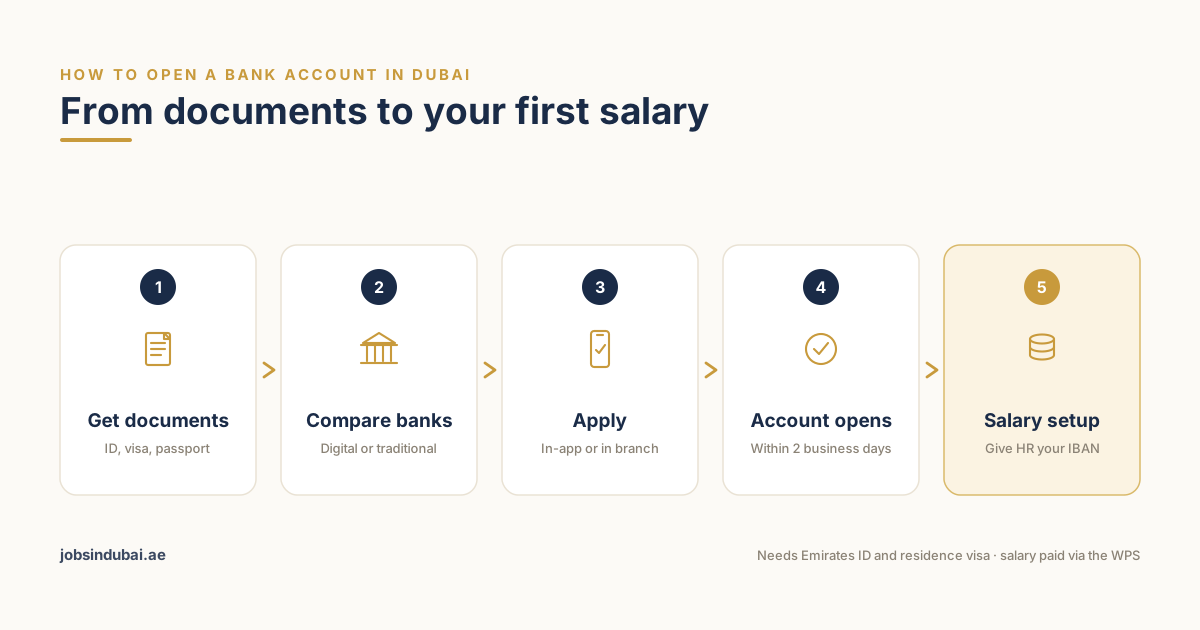
Most banks in Dubai will open a personal account once you have a residence visa and an Emirates ID, and many let you apply through an app. If your employer is registered with MOHRE, your salary will generally be paid through the Wage Protection System (WPS) or another approved method, so it is worth sorting out an account in your first weeks. Here is what to prepare, how the options differ and how to send money home without overpaying.
Key facts
- Banks commonly ask for your Emirates ID, residence visa, passport and a salary certificate or employment letter.
- Banks aim to open a complete, low-risk application quickly, but there is no guaranteed universal timeline, and compliance checks can delay or prevent onboarding. Confirm the current standard for a personal resident account (see below).
- Many accounts have a minimum monthly balance, with a fee if you fall below it. The bank must disclose this before you sign.
- For MOHRE-covered private-sector employers, salaries are paid through the WPS via a bank, exchange house or other payment system authorised by MOHRE.
What you need to open an account
The UAE government portal lists the documents banks most commonly ask for:
- your Emirates ID
- a valid UAE residence visa
- your passport
- a salary certificate or employment letter from your employer
If you are self-employed, expect to show a trade licence and company documents too. Banks run their own “know your customer” (KYC) checks, and each bank’s and product’s requirements differ, so treat this as a list of common documents and check the exact checklist for the account you choose.
Minimum balance and salary requirements
Many banks set a minimum monthly balance and charge a monthly fee if you drop below it, and some accounts require a minimum monthly salary. Requirements differ widely between banks and account types.
CBUAE rules make comparing easier. Banks must give you a Key Facts Statement before you take out a product, say whether the account needs an opening deposit or minimum balance and what happens if you do not maintain it, disclose all fees, and tell you about any low-cost current or savings account they offer. Ask two or three banks for the Key Facts Statement of the account you are considering and compare them side by side.
When can you open one?
Most new residents open an account once their residence visa is issued and they have their Emirates ID; our work visa guide explains how long that takes. Some digital providers may let you start onboarding earlier using your UAE visa details while your Emirates ID is being issued; confirm the provider’s current eligibility, and note the difference between starting an application and having an account actually opened and usable.
On timing, confirm the current CBUAE standard for a personal resident account before relying on a fixed figure. A bank acknowledging or deciding on your application is not the same as opening and activating it, and KYC, sanctions and financial-crime checks can extend or prevent onboarding, so do not assume the regulator guarantees every application will be approved or operational within a set period. If a bank needs more time, it should explain why.
Your first salary may be due before your account is ready, so tell HR early and ask how you will be paid in the meantime. Exchange houses also offer wage-payment services.
If a bank refuses your application: ask the bank for its decision and the reason it is able to disclose (financial-crime rules can limit what a bank may share). Raise a complaint with the bank first. If the bank’s response or its waiting period does not resolve it, and you are eligible, escalate to Sanadak, the UAE’s independent financial-services ombudsman. Another bank may also accept you.
Digital banks vs traditional banks
Digital banks run entirely through an app, including account opening and identity checks. Examples include Wio, a digital bank licensed by the CBUAE, and Liv, a digital banking brand owned by Emirates NBD.
Traditional banks have branches as well as apps, and many let you apply online. They generally offer a wider range of products, such as credit cards, loans, mortgages and Islamic (Sharia-compliant) accounts.
These are neutral examples, not recommendations, and none guarantees approval. Whichever you choose, check:
| Check | Why it matters |
|---|---|
| Minimum balance and fall-below fee | It can cost you every month you dip under |
| Minimum salary | Some accounts are only open to higher earners |
| Chequebook | Many Dubai landlords still ask for rent cheques (see our renting guide) |
| International transfer fees and rates | Important if you send money home |
Salary transfer accounts and the WPS
Companies registered with MOHRE must pay covered employees’ wages through the WPS, which lets the ministry check that private-sector staff are paid in full and on time. Some workers, employers and free-zone arrangements may sit outside the standard MOHRE process or be subject to exceptions, so confirm how you will be paid. Under Ministerial Resolution No. 340 of 2026:
- wages are paid through the WPS or another payment system authorised by MOHRE
- the previous month’s salary is due on the first day of each month
- pay can be in dirhams, or another currency where your contract provides for it (a permitted contractual arrangement, not something you can switch to afterwards)
If a salary is late, MOHRE’s system tracks it from the due date, with alerts to the employer within days and possible suspension of the employer’s new work permits from day five. This is staged enforcement on the employer, not an automatic suspension in every case. Raise a late salary with HR first; if that fails, you can file a complaint with MOHRE.
A salary transfer account is simply the account your employer pays into: give HR its IBAN. Some banks link perks or lower balance requirements to salary accounts, and some loans and credit cards may require you to keep your salary at that bank. Check these conditions in the Key Facts Statement, especially if you might change jobs.
Sending money home
You can send money abroad through your bank, a licensed exchange house or the app of a licensed provider. Exchange houses are licensed and regulated by the CBUAE to carry out remittances. Check that the entity actually providing the service is CBUAE-licensed; an app being available to a UAE resident does not by itself mean the remittance is provided by a UAE-licensed entity.
Under CBUAE consumer rules, providers must:
- show their fees and exchange rate before you confirm, with the fee and the exchange-rate margin shown separately
- warn you that the receiving bank may charge its own fees
- give you an official receipt
Some rules on how a transfer fee is structured (for example, a fixed amount rather than a percentage) may be product- or provider-specific, so do not assume they apply to every provider. Compare the four things separately: the transfer fee, the FX margin, any intermediary or receiving-bank fees, and the amount your recipient actually receives. That last figure is the one to compare: a “zero-fee” transfer with a weak rate can cost more than one with a fee. Only use CBUAE-licensed providers.
For budgeting, see our cost of living guide, and for the rest of your move, our Moving to Dubai guide.
FAQ
Can I open a bank account in Dubai before I get my Emirates ID?
Sometimes. Most banks want your Emirates ID and residence visa, but some digital providers may let you start onboarding with your UAE visa details while your card is being issued. Confirm the provider’s current requirements, and whether you can only start an application or actually open the account at that stage.
Do I need a salary certificate to open a bank account?
Often, yes. A salary certificate or employment letter is one of the most commonly requested documents. Self-employed people usually show a trade licence instead.
What happens if my balance falls below the minimum?
The bank may charge a monthly fee. Any minimum balance and fall-below fee must be disclosed before you open the account.
How long does it take to open a bank account in Dubai?
Banks aim to process a complete, low-risk application quickly, and some approve within hours, but there is no guaranteed universal timeline, and compliance checks can take longer. Confirm the current standard with the bank.
What can I do if a bank refuses to open my account?
Ask the bank for its decision and the reason it can disclose, complain to the bank first, and if unresolved and you are eligible, escalate to Sanadak. Another bank may still accept you.
What is the cheapest way to send money home from Dubai?
Compare how much your recipient will get after fees and the exchange rate, across your bank, licensed exchange houses and licensed apps. Providers must show the fee and rate before you confirm.
Sources and last checked
Last checked 14 Oct 2026.
- Banking in the UAE (u.ae, UAE Government portal)
- Payment of salaries/wages and the Wage Protection System (u.ae)
- Consumer Protection Standards, Notice 1158/2021 (Central Bank of the UAE Rulebook)
- Wio Bank (official website)
- Liv, a brand of Emirates NBD (official website)
- Khaleej Times: UAE Wage Protection System, salary due on the first day of the month (Ministerial Resolution No. 340 of 2026)
- Sanadak: UAE financial-services ombudsman (complaints and eligibility)
Related guides
- Dubai work visa: how employment visas and work permits workHow a Dubai work visa works in 2026: MOHRE work permit, entry permit, medical, Emirates ID, who pays, timelines, changing jobs, bans and grace periods.
- Renting in Dubai: costs, Ejari and how to find a placeHow renting in Dubai works in 2026: rents by area, Ejari, deposits, cheques, DEWA, rent-increase rules, the new shared-housing law and how to avoid scams.
- Cost of living in Dubai: rent, bills and monthly budgetsWhat it costs to live in Dubai in 2026: rent, DEWA bills, transport, school fees and sample monthly budgets for singles and families, with sources.