Company setup in Dubai: options, costs, visas and tax
By Giles Thomas · Last checked 14 Oct 2026
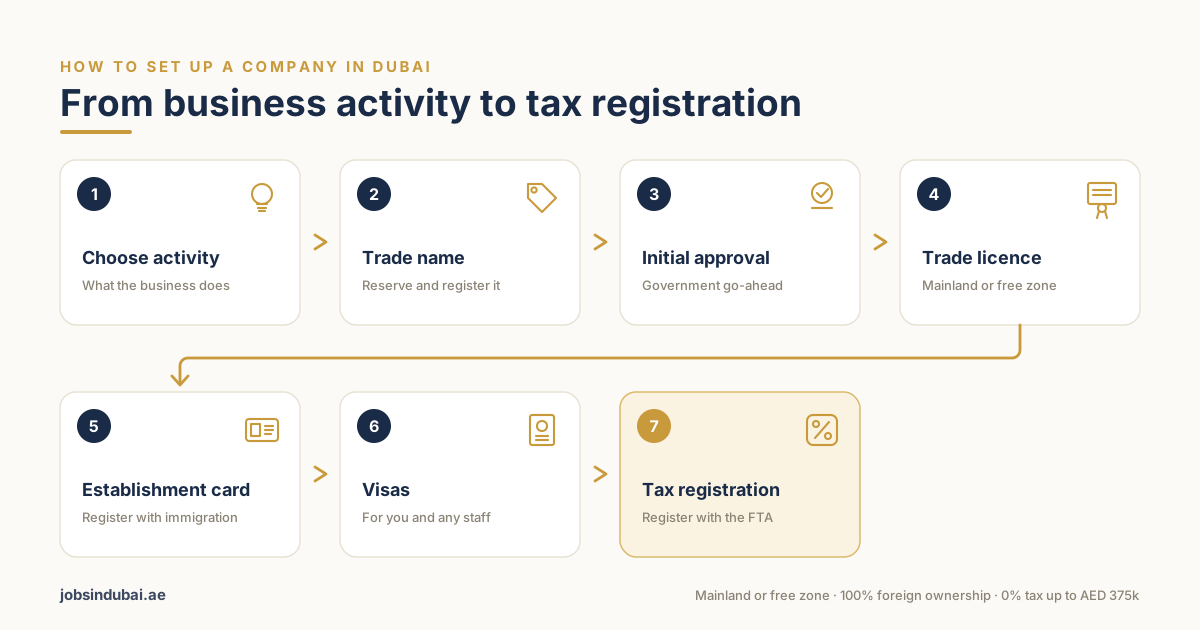
Setting up a company in Dubai means choosing where to register it (the mainland, a free zone or an offshore registry) and then getting a trade licence, an establishment card and visas. Foreign nationals can now own most mainland companies outright, and corporate tax is 0% on the first AED 375,000 of taxable income. Here are the options, costs, visa, banking and tax rules as of October 2026. Fees and rules change often, so confirm current figures with the authority and take professional advice on tax.
Key facts
- Mainland companies are licensed by Dubai Economy and Tourism (DET) and can generally trade across the UAE. Free zone and offshore companies face limits on doing business onshore.
- Foreigners can own 100% of most mainland companies. A short list of activities (including defence, banking, insurance and telecoms) is still restricted or needs specific approvals.
- Published free-zone prices start from around AED 5,750 a year at SPC Free Zone (Sharjah) and from AED 12,500 at Meydan Free Zone (Dubai), before visas (October 2026). These are different packages, not like-for-like totals.
- Corporate tax registration applies to UAE companies and other taxable persons; free-zone status does not itself remove the registration question. Late registration carries a AED 10,000 penalty.
- Corporate tax is 0% on taxable income up to AED 375,000 and 9% above. Small Business Relief (a revenue-based election) currently runs to tax periods ending on or before 31 December 2029.
Mainland, free zone or offshore?
| Mainland | Free zone | Offshore | |
|---|---|---|---|
| Licensed by | Dubai Economy and Tourism (DET) | The zone’s authority (DMCC, Meydan, Dubai Silicon Oasis, etc.) | A registry such as JAFZA Offshore or RAK ICC, via a registered agent |
| Foreign ownership | 100% for most activities | 100% | 100% |
| Where you can trade | Generally across the UAE and abroad (regulated activities and other emirates’ rules can still apply) | In the zone and abroad; the mainland only through an agent, a branch or a permit | Outside the UAE, unless you obtain UAE licences |
| Premises | A registered business location | A flexi desk, co-working space or office in the zone | A registered office, usually the agent’s address |
| Residence visas | Yes, for owners and staff | Yes, depending on package and space | Only in limited cases |
Mainland
Since early 2021, foreign investors have been able to own 100% of most mainland companies. Restrictions remain for activities of strategic impact and certain regulated sectors, such as security, defence and military activities, and parts of telecoms, banking, financing and insurance. These are handled through specific approvals or ownership conditions for the relevant activity, not a blanket ban on every business in those sectors. Some mainland legal forms and activity routes also require a UAE national as a local service agent (see the FAQ); confirm whether yours does with DET.
Free zone
Each free zone has its own authority, rules and prices, and free zones suit businesses that mainly sell abroad. Free-zone companies can trade within their zone and internationally, but to sell on the mainland they need a licensed mainland distributor, a mainland branch or company, or a mainland operating permit. Dubai’s official routes include:
- Free Zone Mainland Operating Permit: launched October 2025 for free-zone companies with a Dubai Unified Licence (the commercial ID DET gives every Dubai business). It costs AED 5,000 per six months and initially covers non-regulated activities such as technology, consultancy, design, professional services and trading. Income from that mainland activity is subject to UAE corporate tax: for a Qualifying Free Zone Person it is likely to be non-qualifying income taxed under the normal corporate-tax rules (on taxable income, not on gross revenue), and it can affect your free-zone tax status, so take advice on how income is allocated between zone and mainland activity.
- Branch licence: under Executive Council Resolution No. 11 of 2025, DET can license a free-zone company’s branch to operate outside the zone (reported at around AED 10,000 a year for a one-year term). Confirm the exact route and current fee on DET’s fee schedule.
Offshore
Offshore companies typically hold assets or do business outside the UAE. A company needs the appropriate licences before doing business in the UAE, and residency visas are possible only in limited cases, such as owning property in a designated freehold area. JAFZA Offshore registration takes 5 to 7 working days and must go through a registered agent.
Licence types
DET’s main mainland licence categories are:
- Commercial: buying and selling goods and services, including import, export and logistics.
- Professional: services based on expertise or skills, such as consultancy.
- Industrial: manufacturing, production, packaging and similar.
DET’s Invest in Dubai platform also lists instant, SME, Intelaq (the last two for UAE and GCC nationals) and e-Trader licences. Free zones issue their own licences, and many also offer freelance permits.
e-Trader is a specific home-based route for selling products and services online and through social media, with its own eligibility conditions (including which applicants can use it and whether it supports staff or visas). It is not a general synonym for every e-commerce licence, so check the current eligible-applicant group and limits on Dubai’s official eCommerce page before relying on it.
The free-zone branch / mainland operating route (sometimes labelled “Dual”) is not a standard activity-based licence category; it is a permission for a free-zone company to operate outside its zone, covered above. Treat it as an operating route, not a licence type.
Freelance permit or company?
A freelance permit is cheaper and simpler, and an individual only registers for corporate tax once business turnover passes AED 1 million a year. A company makes more sense when:
- You want to hire. Freelance permits generally do not let you sponsor staff.
- You want a brand. Freelance permits are issued in your own name.
- Your activity is not on a freelance list, such as trading goods.
- Your clients are mostly mainland businesses.
- You want limited liability (freelancers are personally liable for their debts).
- You have partners or investors.
See the freelance visa guide for that route.
Steps to set up a company
On the mainland
- Choose your business activity.
- Choose a legal form (sole establishment, LLC, etc.).
- Choose your licence type.
- Register a trade name.
- Get initial approval.
- Prepare the memorandum of association and any local service agent agreement.
- Choose your business location.
- Get any other approvals.
- Submit documents and pay within 30 days of the payment voucher, or the application is cancelled.
Documents issued abroad, such as a parent company’s papers, need attestation and legal translation.
In a free zone
Choose a zone and legal entity, reserve a trade name and apply through the authority’s website. Licences are typically issued within 14 working days of approval; some zones are faster (Meydan’s “Fawri” licence is advertised at under an hour).
After you are licensed
- Establishment card: registers your company with immigration so you can apply for visas.
- Visas and work permits for you and any staff.
- Corporate tax registration (deadline depends on your incorporation date and the FTA timeline).
- Beneficial owner register: under Cabinet Decision No. 109 of 2023, file with your registrar within 60 days of licensing.
- Bank account and, once you cross the threshold, VAT registration.
How much does it cost?
These are dated examples from different authorities, not like-for-like totals. They cover different activities, legal forms, workspace and visa allocations, so compare what each includes rather than the headline number, and get a written, itemised quote from the authority before paying any intermediary.
| Example (October 2026) | What it covers | Published price |
|---|---|---|
| SPC Free Zone (Sharjah) | Publishing or e-commerce licence | From AED 5,750/yr licence-only; AED 13,165 for year one with one visa (two different packages) |
| Meydan Free Zone (Dubai) | Licence with a flexi desk, no visas | From AED 12,500, plus AED 1,850 per visa allocation |
| DMCC (Dubai) | Basic Biz Package, one year, single individual shareholder | AED 35,484 |
| JAFZA Offshore | Offshore company registration | AED 10,000 (confirm whether the registered-agent charge is extra) |
| Dubai mainland (DET) | Varies by activity, legal form and location | Get an itemised quote via Invest in Dubai |
On top of the licence, budget for premises, the establishment card and each visa (entry permit, medical test, Emirates ID and health insurance), plus any local service agent, bookkeeping, VAT and a minimum bank balance. Qualifying Free Zone Persons must also keep audited financial statements. Confirm every figure with the authority before you commit.
Visa quotas
- Free zones set visa numbers by package or desk. Dubai Silicon Oasis allows up to two residency visas per flexi desk and three per fixed desk; Meydan allows up to six visa allocations per licence.
- On the mainland, MoHRE sets each company’s work-permit quota. Ask what to expect before signing a lease.
- Every employee needs a work permit; working without one is illegal. See our work permits and visas guide.
Opening a business bank account
UAE banks must check who owns and controls a company before opening an account. Expect to provide:
- your trade licence and memorandum or articles of association
- details of shareholders, managers and beneficial owners (anyone with 25% or more)
- identity documents for owners and signatories
- your business address and an explanation of what the company does
Requirements and minimum balances vary by bank. See our bank account guide.
Corporate tax and VAT basics
This section is high-stakes; confirm each point against current Federal Tax Authority (FTA) and Ministry of Finance guidance, and take professional advice.
- Who registers: UAE-incorporated companies and other taxable persons register with the FTA; free-zone status does not itself remove the registration question, and statutory exemptions and special cases can differ. Individuals, including freelancers, register only if their business revenue exceeds AED 1 million in a calendar year; salary and personal investment income do not count.
- Rates: 0% on taxable income up to AED 375,000 and 9% above. The AED 375,000 band applies to taxable income, not revenue or pre-adjustment accounting profit.
- Small Business Relief: if your revenue is AED 3 million or less in the current and all previous relevant tax periods, you can elect to be treated as having no taxable income. Ministerial Decision No. 131 of 2026 extended this to tax periods ending on or before 31 December 2029. Qualifying Free Zone Persons cannot use it.
- Free-zone companies: a Qualifying Free Zone Person pays 0% on qualifying income and 9% on other taxable income, with no AED 375,000 band. Non-qualifying revenue must stay within the de minimis limit (the lower of AED 5 million or 5% of total revenue). Exceeding it can cause the person to lose Qualifying Free Zone Person status for that tax period and beyond, changing the tax treatment, so this threshold matters.
- Deadlines: the corporate-tax registration deadline depends on the entity’s incorporation date and the FTA’s published timeline; individuals register by 31 March of the year after crossing the threshold. The AED 10,000 late-registration penalty may be waived where the taxable person files its first tax return (or annual statement) within the period set by the FTA, subject to the applicable conditions, so do not treat the waiver as automatic. Returns and payment are due within nine months of each tax period’s end.
- VAT: 5%. Registration is mandatory once taxable supplies and imports exceed AED 375,000 over 12 months (or are expected to within 30 days), and voluntary from AED 187,500.
For the wider picture, see our Moving to Dubai guide.
FAQ
Can a foreigner own 100% of a company in Dubai?
Yes, for most activities, both in free zones and, since early 2021, on the mainland. A short list of strategic or regulated activities (such as defence, banking and parts of telecoms) is restricted or needs specific approvals.
How much does it cost to set up a company in Dubai?
Published examples include from AED 5,750 a year at SPC (Sharjah) and from AED 12,500 at Meydan (Dubai), before visas, and AED 35,484 for DMCC’s Basic Biz Package. These are different packages. Office space, visas and running costs come on top.
Can a free zone company work with mainland clients?
Not freely. It needs an agent or distributor, a branch licence, or Dubai’s Free Zone Mainland Operating Permit (AED 5,000 per six months, requires a Dubai Unified Licence). Mainland income is subject to corporate tax on taxable income.
Do I get a residence visa if I set up a company?
Usually, if your package or premises includes a visa allocation; owners and partners typically get an investor or partner visa. Offshore companies generally do not come with visas.
Do I pay corporate tax if my profit is small?
You still register and file. Taxable income up to AED 375,000 is taxed at 0% (qualifying free-zone companies follow different rules). With revenue of AED 3 million or less you can elect Small Business Relief for tax periods ending by 31 December 2029.
Do I need a local sponsor or service agent?
You do not need a UAE shareholder for most activities. Some mainland legal forms and activity routes, including certain civil (professional) establishments wholly owned by non-GCC nationals, require a UAE national as a local service agent. A local service agent is not a shareholder, sponsor or partner and does not take ownership or profits. Not every foreign-owned LLC needs one, so confirm the requirement for your exact activity and legal form with DET. Free-zone companies generally do not need one.
Sources and last checked
Last checked 14 Oct 2026.
- u.ae: Steps to start a business on the mainland
- u.ae: Full foreign ownership of commercial companies
- u.ae: Starting a business in a free zone
- u.ae: Running a business in a free zone
- u.ae: Work permits
- Dubai.ae: Starting a business (mainland licence types)
- Invest in Dubai (DET): Dubai mainland business set-up
- Dubai Legislation Portal: Executive Council Resolution No. (11) of 2025 Regulating the Conduct of Free Zone Establishments' Activities
- Dubai Media Office: Dubai launches Free Zone Mainland Operating Permit (October 2025)
- Dubai Media Office: DET launches the Dubai Unified Licence (December 2023)
- Federal Tax Authority: Corporate Tax registration
- Federal Tax Authority: Decision No. 3 of 2024 on the Corporate Tax registration timeline
- Ministry of Finance: Extension of Small Business Relief until 31 December 2029 (August 2026)
- Ministry of Finance: Federal Decree-Law No. 47 of 2022 on corporate tax, with amendments
- Federal Tax Authority: Small Business Relief
- Federal Tax Authority: Basic tax information bulletin, Free Zone Persons
- Federal Tax Authority: Taxation of natural persons guide
- Federal Tax Authority: Registration for VAT
- Ministry of Economy and Tourism: Cabinet Decision No. 109 of 2023 on beneficial owner procedures
- Central Bank of the UAE: Guidance on customer due diligence for licensed financial institutions
- JAFZA: Setting up a new offshore company
- JAFZA: Offshore Companies Regulations 2023
- RAKEZ: Freelancer Permit
- Meydan Free Zone: Company setup cost breakdown (updated June 2026)
- DMCC: Dubai free zone company setup cost (February 2026)
- SPC Free Zone: Sharjah free zones guide (updated October 2026)
- Dubai Silicon Oasis: Co-working and workstations
- Dubai Media Office: Executive Council Resolution No. 11 of 2025 on free zone establishments operating outside the zone (March 2025)
- Dubai.ae: eCommerce licences, including e-Trader
Related guides
- Freelance visa in Dubai: permits, costs and how to applyFreelance visa Dubai guide for 2026: compare permit routes, eligibility, documents, step-by-step application, full costs and what the permit allows.
- How to open a bank account in Dubai as a new residentWhat you need to open a bank account in Dubai as a new resident: Emirates ID, visa, salary letter, minimum balances, digital banks and WPS salaries.
- Dubai work visa: how employment visas and work permits workHow a Dubai work visa works in 2026: MOHRE work permit, entry permit, medical, Emirates ID, who pays, timelines, changing jobs, bans and grace periods.