Health insurance in Dubai: the rules, basic cover and what to check
By Giles Thomas · Last checked 14 Oct 2026
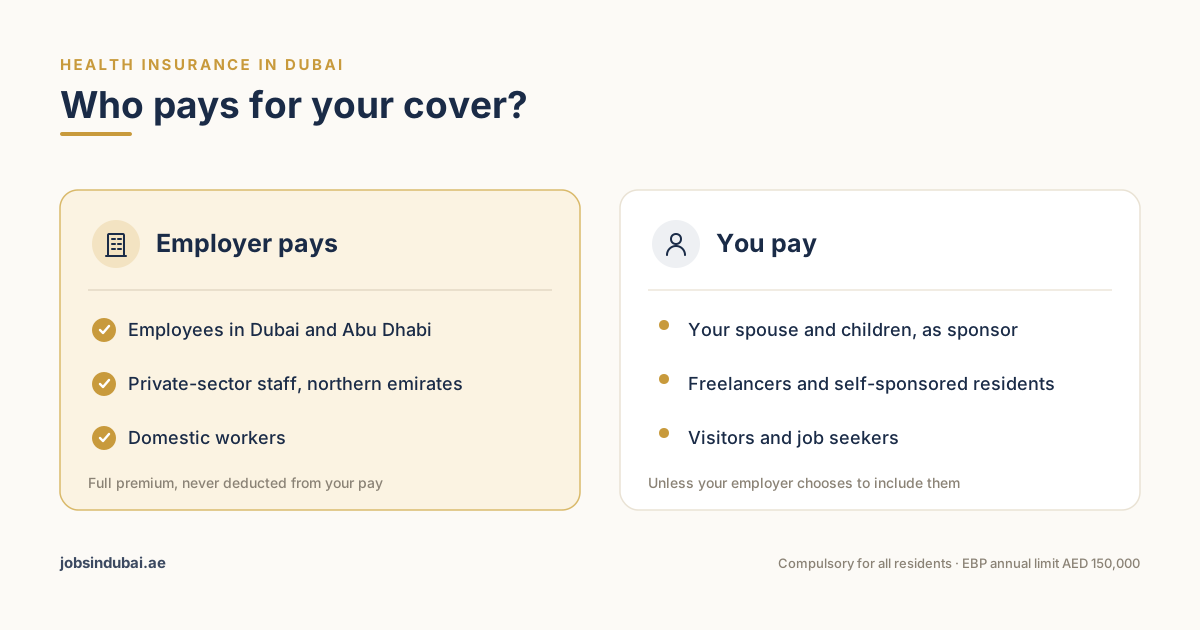
Health insurance is compulsory for residents of Dubai, and if you are employed, your employer must provide your cover and pay for it. Since 1 January 2025, a federal rule has also required employer-paid cover for private-sector workers in the northern emirates. Here is what the rules say, what basic plans include and what to check in your own policy. Premiums and benefit schedules change, so confirm current figures before relying on them.
Key facts
- In Dubai, employers must insure their employees, and sponsors must insure their resident dependants.
- Employers pay for their staff’s cover; in Dubai, charging an employee for it can bring an AED 10,000 fine per person.
- Dubai’s minimum-benefit plan, the Essential Benefits Plan (EBP), has an annual limit of AED 150,000 (confirm the current schedule).
- The federal basic package for the northern emirates is priced at AED 320 per person per year, on a two-year policy.
- Freelancers and other self-sponsored residents buy their own cover.
Is health insurance mandatory?
Yes, though the rules depend on the emirate.
Dubai
Under Dubai’s Health Insurance Law (Law No. 11 of 2013), employers must insure their employees, and sponsors must insure their resident dependants unless the sponsor’s employer covers them. The law was phased in from 2014, with fines enforced from 2017, and the Dubai Health Authority (DHA) regulates the system.
These are resident insurance obligations. Visitor and travel-visa medical-cover requirements can arise under different rules and vary by entry route, so they are not the same thing: an ordinary visitor is not covered by the resident EBP, and the resident-employer rules do not apply to them. If you are visiting or job hunting on a visit visa, check the current visa/travel conditions and arrange suitable medical cover of your own.
Employers must bear the full cost of employees’ premiums and must never deduct it from salaries. Fines include AED 500 for each month an employer or sponsor delays enrolling someone, AED 10,000 per person for charging them for their cover (plus a refund), and AED 1,000 per incident for failing to ensure the worker has their insurance card or digital proof of cover.
Abu Dhabi
Employers and sponsors must provide health insurance for employees and eligible family members, covering up to one spouse and three children under 18. Confirm with the Department of Health, Abu Dhabi who covers each person: the employee’s cover is the employer’s duty, and for dependants check whether the employer or the sponsor pays, and what happens for additional dependants or anyone already insured elsewhere.
Sharjah and the northern emirates
Since 1 January 2025, employers must buy health insurance for private-sector employees and domestic workers before their residence permits are issued or renewed, extending the compulsory system already in place in Abu Dhabi and Dubai to Sharjah, Ajman, Umm Al Quwain, Ras Al Khaimah and Fujairah. Workers with existing valid permits come under the rule when their residence is renewed.
The federal basic package is priced at AED 320 per person per year; the policy is issued for two years, and the second year’s premium is refundable if the visa is cancelled. It covers people aged 1 to 64 (older workers complete a medical disclosure form). This federal package is not the Dubai EBP. Family members can be added under the scheme’s own eligibility and documentation terms, so dependants are not covered automatically just because they can join.
Employer cover or paying for it yourself
| Who | Who arranges and pays |
|---|---|
| Employee in Dubai or Abu Dhabi | Employer |
| Private-sector employee or domestic worker in the northern emirates | Employer |
| Eligible dependants (spouse, children) in Dubai | You, as sponsor, unless your employer covers them |
| Eligible dependants in Abu Dhabi | Employer or sponsor per the Abu Dhabi rule (confirm, per the section above) |
| Freelancer or other self-sponsored resident | You |
| Visitor or job seeker on a visit visa | You, under visitor/travel cover rules, not the resident EBP |
Employers can offer more than the legal minimum, and you can buy supplementary cover on top of a basic policy. Ask HR which plan you will be on before you accept an offer.
What basic cover includes
Two things are easy to confuse. The EBP is Dubai’s minimum-benefit standard that a compliant Dubai policy must meet, and it is also the specific low-cost product that DHA-approved insurers offer to workers in the DHA’s low-salary band. Not every Dubai resident buys the EBP product at its headline price: eligibility for that exact product depends on the salary band and applicant type, and dependants or self-sponsored residents may need a different compliant plan. Confirm who can buy the EBP product, the current low-salary-band threshold, and what a quote is for your situation.
The figures below are a summary of the EBP Table of Benefits and the federal package’s benefits, not a policy schedule. Treat cover as subject to the insurer’s current network, exclusions and policy wording.
| Benefit | Dubai EBP | Federal basic package |
|---|---|---|
| Price | Indicative AED 550–750 a year plus VAT (DHA 2025 band; confirm it is current and for which applicant group) | AED 320 per person per year |
| Annual limit | AED 150,000 | Not stated on the government portal |
| In-patient | 20% co-pay, capped at AED 500 per encounter and AED 1,000 a year | 20% co-pay, capped at AED 500 per visit and AED 1,000 a year, including medicines |
| Out-patient | 20% co-pay per visit; none for a follow-up within seven days | 25% co-pay, capped at AED 100 per visit; none for a follow-up within seven days |
| Medicines | 30% co-pay; AED 2,500 annual limit | 30% co-pay; AED 1,500 annual cap |
| Maternity | 10% co-pay; up to AED 10,000 per delivery | Not detailed on the government portal |
| Pre-existing / chronic | Must be covered; may be excluded for the first six months | No waiting period for chronic illnesses |
Under the EBP, basic care is covered within Dubai and emergency treatment anywhere in the UAE, and you need a GP referral before seeing a specialist. The plan includes limited dental (AED 500) and out-patient mental-health (AED 800) cover, and covers a newborn for 30 days from birth. Exclusions include cosmetic treatment and IVF.
Dependants
In Dubai, insuring your spouse and children is your responsibility as their sponsor unless your employer includes them, which the DHA encourages. Newborns are covered under the mother’s EBP policy for 30 days and must then be enrolled on a policy, as a dependant or individually. Budget for family premiums before you move: see our cost of living guide.
Freelancers and the self-sponsored
If you do not have an employer or sponsor in Dubai, you must arrange your own cover. Some visas add conditions, but the exact insurance requirement can depend on the category, sponsor and emirate, so confirm with the issuing authority: the Golden Visa generally requires comprehensive cover for you and your family, and the remote work visa requires valid health insurance. Check the current ICP/GDRFA guidance for your specific category. If you are going self-employed, read our freelance visa guide. Job hunting on a visit visa? You are not covered by the resident EBP, so travel with your own medical cover and check the current visa conditions.
How to check your cover
- Insurance card or digital proof: your employer must ensure you have it.
- Table of benefits: ask HR for it and check the annual limit, co-pays and medicine limit.
- Network and area: which hospitals and clinics you can use, and whether routine care is covered outside Dubai.
- Maternity, pre-existing conditions and dependants: check limits, waiting periods and who is on the policy.
- The insurer: the DHA publishes lists of permitted insurers and claims administrators.
- Leaving a job: in Dubai, cover must continue for a period after your visa is cancelled (commonly cited as 30 days) or until you leave the UAE, whichever comes first. Distinguish your employment end date, visa cancellation, the policy’s actual expiry and your departure, as these can differ; other emirates may use a different rule. Your visa grace period may be longer (see our work visa guide).
If a claim is refused: complain to your insurer first. If that does not resolve it, the route depends on the issue and emirate: the health regulator (DHA, or the Department of Health in Abu Dhabi) for a cover or network dispute, and Sanadak where the complaint is eligible and the insurer’s escalation conditions are met. These are not interchangeable, so use the one that fits your case. For the rest of your move, see our Moving to Dubai guide.
FAQ
Is health insurance mandatory in Dubai?
Yes, for residents. Employers must insure their employees, sponsors their dependants, and residents without an employer or sponsor must buy their own cover. Visitors arrange their own travel/medical cover under separate rules.
Can my employer deduct health insurance from my salary?
Not in Dubai. Employers must pay the full premium, and charging an employee can bring a fine of AED 10,000 per person plus a refund.
Does my employer have to insure my family?
Not in Dubai, where sponsors are responsible for dependants, although employers are encouraged to cover them. Abu Dhabi’s rules make employers and sponsors responsible for eligible family members (up to one spouse and three children under 18); confirm who pays.
Do freelancers need health insurance in Dubai?
Yes. Without an employer or sponsor, you must buy your own policy, and health insurance is among the documents required for residence.
What happens to my health insurance if I lose my job?
In Dubai, cover must continue for a period after your visa is cancelled (commonly 30 days) or until you leave, whichever comes first. After that you need new cover.
Am I covered in other emirates?
On Dubai’s EBP, emergencies are covered anywhere in the UAE, but routine care only in Dubai unless your insurer extends it. Confirm this against your policy’s network.
Sources and last checked
Last checked 14 Oct 2026.
- Getting health insurance (u.ae, UAE Government portal)
- ISAHD frequently asked questions (Dubai Health Authority)
- Health insurance law and regulations (Dubai Health Authority, ISAHD)
- GC 03/2024: Updated Table of Benefits for the Essential Benefits Plan (Dubai Health Authority)
- GC 06-2024: Participating insurers permitted to offer the Essential Benefits Plan to low salary band members (Dubai Health Authority)
- Executive Council Resolution No. 7 of 2016 Approving Health Insurance Fees and Fines in the Emirate of Dubai
- Executive Council Resolution No. 6 of 2017 Approving the Health Insurance Implementation Phases in the Emirate of Dubai
- Administrative Resolution No. 78 of 2022 Issuing the Implementing Bylaw of Law No. 11 of 2013 (Dubai Health Authority)
- Permitted companies: insurers, claims administrators and intermediaries (Dubai Health Authority, ISAHD)
- General provisions for the residence visa (u.ae)
- Golden Residency guide (ICP)
- Visa issuance (virtual work) (GDRFA Dubai)
- Gulf News: UAE's mandatory health insurance for workers starts today, everything you need to know (January 2025)
- Gulf News: UAE workers, a guide to the new basic health insurance benefits and exclusions (January 2025)
- Sanadak: UAE financial-services ombudsman (complaints and eligibility)
Related guides
- Dubai work visa: how employment visas and work permits workHow a Dubai work visa works in 2026: MOHRE work permit, entry permit, medical, Emirates ID, who pays, timelines, changing jobs, bans and grace periods.
- Freelance visa in Dubai: permits, costs and how to applyFreelance visa Dubai guide for 2026: compare permit routes, eligibility, documents, step-by-step application, full costs and what the permit allows.
- Cost of living in Dubai: rent, bills and monthly budgetsWhat it costs to live in Dubai in 2026: rent, DEWA bills, transport, school fees and sample monthly budgets for singles and families, with sources.