Dubai work visa: how employment visas and work permits work
By Giles Thomas · Last checked 14 Oct 2026
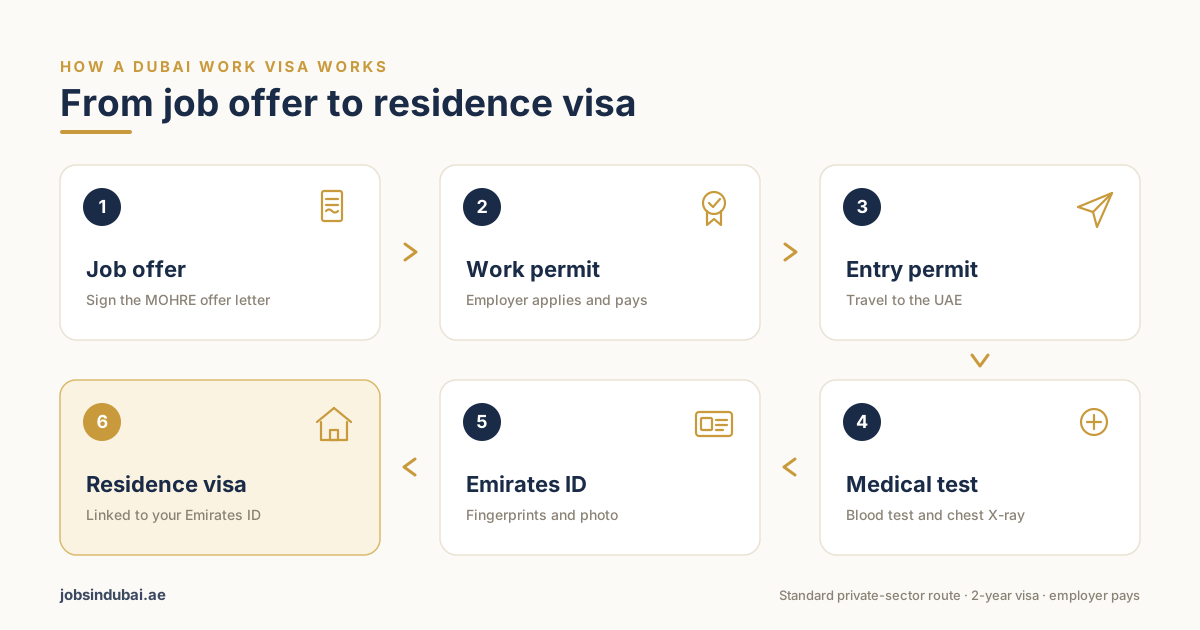
Most people who move to Dubai for a job live there on an employer-sponsored residence visa, usually called a work visa. Your employer arranges a work permit and entry permit, then your medical test, Emirates ID and residence visa after you arrive, and UAE law says the employer pays. This guide explains each step, how long it takes, and what happens when you change jobs or your visa is cancelled.
Rules, fees and timings change and can vary by authority, emirate and worker category. Treat the figures below as a guide and confirm your own situation with MOHRE, GDRFA or ICP.
Key facts
- Your employer sponsors your visa and pays for it. Charging job seekers recruitment or employment costs is illegal in the UAE (Federal Decree-Law No. 33 of 2021).
- A standard private-sector work residence visa typically lasts two years and can be renewed. Other categories differ.
- Two separate 60-day clocks apply on the employer-sponsored route: you must enter the UAE within 60 days of the entry permit being issued, and then complete residence within 60 days of arriving.
- A visit or tourist visa alone does not authorise employment.
- After cancellation there is a grace period to find a new job or leave. GDRFA lists 60 days for a Dubai private-sector residence permit; some categories get longer. Check your own file (see below).
- Overstaying costs AED 50 a day in the relevant categories.
How a Dubai work visa works
A “work visa” is really two approvals:
- A work permit from the Ministry of Human Resources and Emiratisation (MOHRE), which allows a company to employ you. MOHRE issues several permit types; new arrivals usually get the two-year permit for recruiting a worker from outside the UAE.
- A residence visa, tied to your Emirates ID, which lets you live in the UAE. In Dubai it comes from the General Directorate of Residency and Foreigners Affairs (GDRFA); elsewhere from the Federal Authority for Identity, Citizenship, Customs and Port Security (ICP).
Free-zone employers normally handle the permit stage through their free-zone authority instead of MOHRE. Another type, the part-time permit, lets you work for more than one employer with ministry approval, useful if you are considering part-time jobs. The broad steps are similar for jobs in Abu Dhabi and the northern emirates, but the authorities, permit types and specific requirements differ by emirate and free zone, so check the rules for where you will actually work.
Before you start: the offer letter and your documents
The MOHRE offer letter
Your first official document is a job offer issued through MOHRE’s system. Your employer signs it electronically and sends it to you, directly or through an agency, and you sign it before the work permit application goes in. Check the salary, allowances, job title, hours and notice period carefully: your contract must match it.
- The offer is issued in Arabic and in English (or another language the worker understands); confirm the exact language requirement with MOHRE for your case.
- After you arrive, you both sign it again and MOHRE registers it as your employment contract. Confirm the registration deadline (commonly cited as within 14 days) and what event starts that clock with MOHRE.
- You can check an offer’s reference number on MOHRE’s application status service, and confirm the company is listed in the National Economic Register.
Red flags include being asked to pay for a visa or permit, an offer that is not on MOHRE’s system, or being told to start work on a visit visa while the papers are processed. If you use an agency, pick a licensed recruitment agency; nobody may legally charge you recruitment fees.
Getting your degree attested
MOHRE asks for academic certificates according to the job’s skill level: a bachelor’s degree or higher for levels 1 and 2, a diploma for levels 3 and 4, and a high-school certificate for level 5. Levels 6 to 9 need none. To be classed as skilled, your certificate must be attested.
Attestation generally means having the document verified by the authorities in the issuing country, then attested by the UAE embassy or consulate there, applying through the UAE Ministry of Foreign Affairs’ attestation service. The chain varies by country, so check first and start early. Ask your employer whether it will reimburse the cost.
Step by step: from job offer to Emirates ID
| Step | What happens | Who does it | Official timing |
|---|---|---|---|
| 1. Job offer | You sign the MOHRE offer letter | You and employer | – |
| 2. Work permit | Employer applies and pays the fees | Employer | Work Bundle’s published target is five working days once the employer submits |
| 3. Entry permit | Lets you travel to the UAE | Employer | Use within 60 days of issue |
| 4. Arrival | You enter, or change status if already here | You | Complete residence within 60 days of arrival |
| 5. Medical test | Blood test and chest X-ray | You attend; employer pays | – |
| 6. Emirates ID biometrics | Fingerprints and photo | You attend; employer pays | – |
| 7. Contract | Offer re-signed and registered with MOHRE | You and employer | Confirm deadline with MOHRE |
| 8. Residence visa | Issued and linked to your Emirates ID | Employer | GDRFA lists 48 hours |
Steps 5 to 8 can happen in a different order. The five-working-day figure is the official Work Bundle service’s published target for the permit-and-residence steps once the employer submits a complete application, not a guarantee that your whole move finishes in five days: attestation, your notice period, employer readiness and exceptions can extend the overall timeline.
Work permit
Your employer applies through MOHRE with your signed offer. The company needs a valid licence free of violations, the job must match its licensed activity, and you must be at least 18. Regulated professions, such as doctors and teachers, also need a professional licence. Once approved, the employer pays the fees plus a bank guarantee or insurance.
Entry permit
GDRFA issues entry permits in Dubai, ICP elsewhere. You must enter within the permit’s 60-day validity, then complete residence within 60 days of arrival. These are two separate deadlines: the first is about entering the country, the second about finishing your residence processing once you are in. If you are already in the UAE on a visit visa, your employer applies for a change of status instead, so you do not need to leave.
Medical test and Emirates ID
Everyone aged 18 or over applying for residence must pass a medical test; in Dubai it typically involves a blood test and chest X-ray at an authorised centre. You also give fingerprints and a photo for your Emirates ID, delivered by courier. You must carry it, and it expires with your residence.
Residence visa: no more passport stamp
GDRFA issues private-sector residence permits, commonly for two years. The UAE began replacing passport residence stickers with the Emirates ID in 2022, so the card is now your main proof of residence, and you can view your residence details through the authorities’ online services. Your employer may need your passport during processing, but confiscating it is illegal.
Dubai also requires employers to insure their staff, and proof of cover is part of the residence process. See our health insurance guide.
Who pays for what
Article 6 of the UAE Labour Law (Federal Decree-Law No. 33 of 2021) bars employers from charging workers recruitment or employment costs, directly or indirectly, including through salary deductions. Government guidance confirms the employer pays for your entry visa, the medical test and your residence permit. This table concerns your own employment costs, not optional extras or dependant costs.
| Cost | Who pays |
|---|---|
| Work permit, entry permit and any change of status | Employer |
| Flight to the UAE to take up the job | Employer (confirm the specific basis with your contract/offer; the recruitment-cost prohibition is the general rule) |
| Medical test, Emirates ID and residence visa | Employer |
| Your health insurance in Dubai | Employer; it cannot be deducted from your pay |
| Visas and insurance for family members | Usually you, as their sponsor, unless your package includes them |
| Degree attestation | Not set out in official guidance, so agree it in writing |
Selected government fees (published figures, checked 14 Oct 2026)
Confirm each at the official service page before relying on it; totals can vary by service channel, emirate and applicant status, and some lines combine a base fee, VAT, a refundable deposit and service charges.
| Item | Fee | Notes |
|---|---|---|
| MOHRE work permit (two years) | AED 250 to AED 3,450 | Depends on the company’s MOHRE category (A, B or C); employer pays. Government fee |
| Dubai work entry visa (GDRFA) | AED 200 + 5% VAT | A higher amount applies if you change status inside the UAE (confirm the current figure); employer pays. Government fee |
| Dubai jobseeker visit visa (GDRFA) | AED 200 (60 days), AED 300 (90 days) or AED 400 (120 days) + VAT | Base fee only; plus a separate refundable AED 1,000 deposit and related fees. You pay. Reconfirm current amounts |
| Overstay fine | AED 50 a day | Applies once your visa or grace period runs out, in the relevant categories |
If anyone asks you to pay for your work permit or employment visa, treat it as a warning sign.
How long it takes
The government’s Work Bundle platform combines the work permit, residence visa, medical test and Emirates ID into one process. The official portal states it has cut processing from 30 working days to five, and in-person visits from seven to two. That is the service’s published claim for its own steps. In practice the overall timeline also depends on degree attestation, your notice period, your employer’s internal approvals and your travel date. Once the entry permit is issued, the two 60-day clocks apply, and missing the second means overstay fines.
Job hunting on a visit visa
The jobseeker visit visa
The UAE offers a dedicated jobseeker visit visa that needs no sponsor or host. It lasts 60, 90 or 120 days. You need a bachelor’s degree or equivalent, and must either be a skilled worker at MOHRE level 1, 2 or 3 or a recent graduate of one of the world’s top 500 universities. You will also need an attested qualification certificate and a financial guarantee. Apply through GDRFA in Dubai or ICP elsewhere.
This is a specific route with its own eligibility. Many people instead job hunt on an ordinary visit or tourist visa, and what you can get there depends on your nationality, so check with GDRFA or ICP before you travel. Neither route lets you work: a visit or tourist visa alone does not authorise employment (UAE work-permit rules).
What you cannot do on a visit visa
- Work. Starting before your permit is issued leaves you without a registered contract or salary protection, and employers who hire without a work permit face fines of AED 100,000 to AED 1 million. That penalty is on the employer, not a fine charged to the job seeker.
- Overstay. Fines are AED 50 a day. If you land a job while visiting, your employer can change your status without you leaving.
When you are ready, browse current openings on our jobs board.
Changing jobs
When you can move
You can work for a new employer once your contract ends lawfully: it expired without renewal, it was ended on grounds set out in the Labour Law, or your employer ended it through no fault of yours. In most cases you no longer need a no-objection certificate from your old employer. Notice periods must be 30 to 90 days, although both sides can agree to shorten or waive them.
Moving during probation
Probation can last up to six months. To join another UAE employer during probation, give at least one month’s written notice; the new employer is then expected to compensate your current one for recruitment costs, unless agreed otherwise. Check your contract for any clause about recruitment costs before you resign.
Be careful about leaving the country. Under the ministerial resolution on one-year work-permit bans, if you resign during probation and depart, you can be barred from a new work permit for one year from your departure date, unless your employer breached the contract. The same ban applies if a proven work-abandonment (absconding) report is filed against you, or if your permit was with a fictitious company. Some workers, including Golden Visa holders and people on family residence visas, are exempt from the work-abandonment ban. Check the specific article for your situation.
How a transfer works
Your new employer applies to MOHRE for a transfer work permit, typically valid for two years. Your old permit and residence are cancelled and a new residence visa is issued, usually without you leaving the country. Do not start the new job until the new permit is issued.
Cancellation and grace periods
When your job ends, your employer cancels your work permit and then your residence visa. Read anything you are asked to sign, keep copies, and make sure your final salary and end-of-service dues are settled. If you sponsor family members, their visas depend on yours; dependants typically get a grace period after their visas are cancelled or expire.
Your own grace period depends on your residence category. GDRFA lists 60 days for Dubai private-sector residence permits, and some categories, such as Golden and Green Visa holders, get up to six months. In that time you can find a new job and have your new employer apply for a permit, switch to another visa, or leave.
Do not rely on what colleagues were given: check your own deadline with ICP’s online file-validity service or with GDRFA. After the grace period, overstay fines of AED 50 a day apply. Your health insurance may run out sooner: in Dubai, cover is required to continue for a period after cancellation (commonly cited as 30 days) or until you leave, whichever comes first; confirm the current rule.
Golden Visa, Green Visa and other routes
Long-term visas let you live in the UAE without relying on one employer’s sponsorship.
| Visa | Length | Main criteria for employees |
|---|---|---|
| Golden Visa (skilled professionals) | 10 years | MOHRE occupational level 1 or 2, salary from AED 30,000/month, bachelor’s degree or equivalent, valid work permit and contract, health insurance for you and your family |
| Green Visa (skilled employees) | 5 years, renewable | MOHRE level 1, 2 or 3, bachelor’s degree, salary from AED 15,000/month, valid employment contract |
| Remote work visa | 1 year, extendable | Remote work for an employer outside the UAE, income from US$3,500/month, health insurance |
Criteria and thresholds change, so confirm current requirements with ICP or GDRFA. Golden Visa holders still need a work permit to take a job, but their residence does not depend on the employer. The Green Visa also has a route for freelancers and the self-employed: see our freelance visa guide. For the rest of your move, start with our moving to Dubai guide, and once your residence is issued, open a bank account.
FAQ
How long does it take to get a Dubai work visa?
The Work Bundle platform aims to complete the permit and residence steps in five working days once your employer submits a complete application. Attestation, notice periods and travel usually make the whole move take longer.
Can I work in Dubai on a visit visa?
No. You can job hunt on a visit visa, but you cannot work until your work permit is issued. If you get an offer, your employer can change your status inside the UAE.
Can my employer make me pay for my visa?
No. Employers cannot charge workers recruitment or employment costs, directly or through salary deductions. That covers your work permit, entry permit, medical test, Emirates ID and residence visa.
How long is a Dubai work visa valid?
A standard private-sector residence permit commonly lasts two years and can be renewed. Your Emirates ID expires at the same time. Other categories differ.
Do I need my degree attested for a Dubai work visa?
For skilled jobs, usually yes. MOHRE asks for academic certificates for skill levels 1 to 5, and they must be attested for you to be classed as skilled.
Can I change jobs in Dubai without a ban?
Often, but it depends on why and how the contract ends. If your contract ends lawfully and you serve your notice, you can usually move without a ban. A one-year work-permit ban applies in specified cases, mainly resigning during probation and then leaving the UAE (unless the employer breached the contract), or a proven work-abandonment report. Check your own situation against the current rules.
How long can I stay in Dubai after my visa is cancelled?
GDRFA lists 60 days for Dubai private-sector residence permits, and some categories get up to six months. Check your own deadline with ICP or GDRFA: fines of AED 50 a day apply afterwards.
Can I sponsor my family on a work visa?
Usually, if you earn at least AED 4,000 a month, or AED 3,000 plus accommodation, and meet the housing requirement. You can sponsor your spouse, unmarried daughters, sons under 25 and children with special needs. Their visa and insurance costs are yours unless your package includes them.
Sources and last checked
Last checked 14 Oct 2026.
- Federal Decree-Law No. 33 of 2021 regulating labour relations, Article 6: employers may not charge workers recruitment or employment costs (u.ae)
- Ministerial Resolution No. 47 of 2022: conditions for a one-year work-permit ban (u.ae)
- Recruiting on the mainland: work-permit process and 60-day permit validity (u.ae)
- Work permits (u.ae, UAE Government portal)
- Job offers and the employment process (u.ae)
- Protection of workers' rights (u.ae)
- Employment of expatriates in privately held companies (u.ae)
- Professional levels of jobs in the UAE (u.ae)
- Employment contracts: duration and models in the private sector (u.ae)
- Terminating employment contracts and arbitrary dismissal (u.ae)
- Banning the issuance of a new work permit for one year (u.ae)
- Tips to avoid labour and visa fraud (u.ae)
- Work visa (u.ae)
- General provisions for the residence visa (u.ae)
- Jobseeker visit visa (u.ae)
- Residence visa for families of employees (u.ae)
- Emirates ID (u.ae)
- Residence visa for work (Dubai.ae)
- Issuing residence permits for the private sector (GDRFA Dubai)
- Visa issuance for foreigners linked with job contract (GDRFA Dubai)
- Issuing a visit visa to explore job opportunities (GDRFA Dubai)
- Visa issuance (virtual work) (GDRFA Dubai)
- Issuance of a visa: entry permits (ICP)
- Issuing residency permit (ICP)
- Golden Residency guide (ICP)
- Green Residence guide (ICP)
- Documents attestation (UAE Ministry of Foreign Affairs)
- Administrative Resolution No. 78 of 2022 Issuing the Implementing Bylaw of Dubai's Health Insurance Law (Dubai Health Authority)
- UAE: How to apply work permit for overseas workers; fees, process explained (Khaleej Times, May 2025)
- UAE job change rules: How to avoid a one-year work permit ban (Khaleej Times, May 2026)
- UAE ministry sets conditions for job transfers during probation period (Gulf News, August 2025)
- Is it legal for employers in the UAE to deduct visa costs from your salary? (Gulf News, April 2025)
- UAE's Emirates ID replaces visa sticker in passport as proof of residency (Gulf News, April 2022)
- UAE residence visa grace periods: rules and how to check online (Gulf News, updated July 2026)
- UAE Federal Law on Labour Relations Organisation issued (LexisNexis Middle East, August 2024)
Related guides
- Freelance visa in Dubai: permits, costs and how to applyFreelance visa Dubai guide for 2026: compare permit routes, eligibility, documents, step-by-step application, full costs and what the permit allows.
- Health insurance in Dubai: the rules, basic cover and what to checkIs health insurance mandatory in Dubai? What employers must provide, what basic plans cover, dependants, freelancers and how to check your cover.
- How to open a bank account in Dubai as a new residentWhat you need to open a bank account in Dubai as a new resident: Emirates ID, visa, salary letter, minimum balances, digital banks and WPS salaries.